

About Funding
- How Much Funding is Available?
How RHTP Funding Works: The Two Streams of Support for Missouri
The RHTP will distribute a total of $50 billion nationwide over five federal fiscal years (2026-2030), with $10 billion made available each year.1
1. Baseline Funding (50% of Total)
Half of the program's total funds ($25 billion over five years) are designated as Baseline Funding.1 This money is divided equally among all states that have an approved application. This provides a stable, predictable funding stream that Missouri can count on each year to form the foundation of its transformation plan. If all 50 states are approved, this would amount to approximately $100 million per state annually.10
2. Workload Funding (50% of Total)
The other half of the program's funds ($25 billion over five years) is designated as Workload Funding.1 This funding is distributed competitively based on a formula that evaluates two things: a state's level of rural need and the quality of its transformation plan.1 This creates an opportunity for Missouri to earn significant additional funding by clearly demonstrating its rural health challenges and presenting a thoughtful, strategic, and high-impact plan for the future.
How Much Did Missouri Receive?
Missouri Department of Social Services (DSS) announced that the Centers for Medicare & Medicaid Services (CMS) has approved $216,276,817.66 in Year 1 (through September 30, 2027) funding for the state’s Rural Health Transformation Program (RHTP), marking a major step forward in strengthening and stabilizing rural health care across the state. The funding launches full implementation of Transformation of Rural Community Health (ToRCH) Care – Missouri’s statewide transformation strategy.
To view the Year 1 budget narrative and funding breakdown, visit the MO RHTP Year 1 Fund Distribution.
- Funding Timeline
Funding Timeline
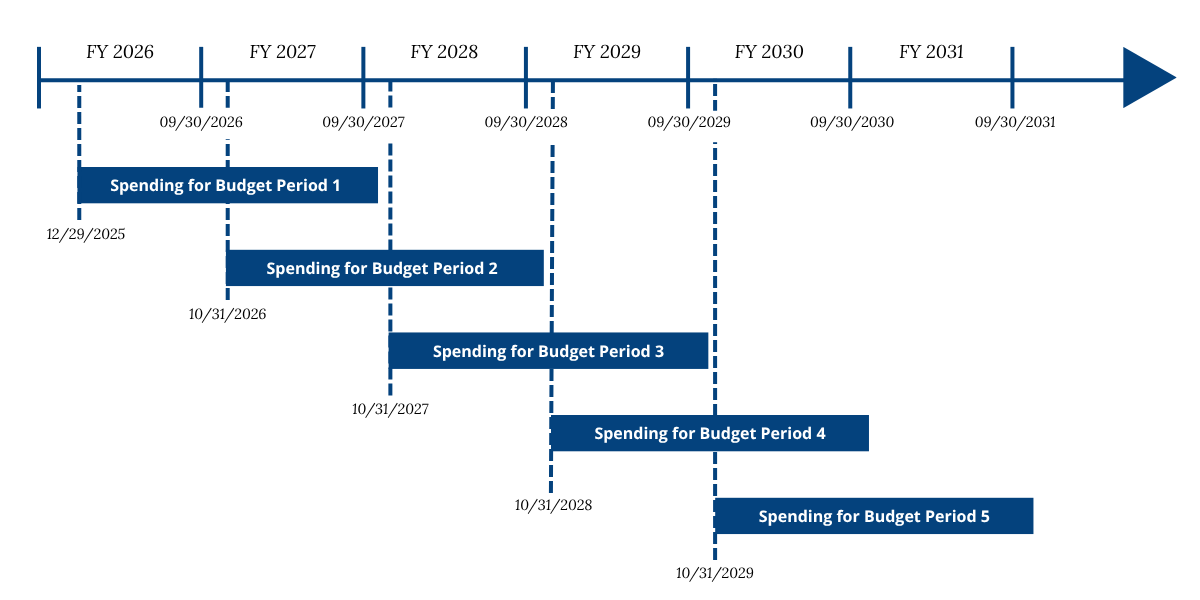
Funding is awarded in five annual budget periods. A key feature of the program is its flexibility; for each budget period, Missouri will have until the end of the following federal fiscal year (September 30) to spend the awarded funds.1 For example, funds awarded for the first budget period in early 2026 can be spent until September 30, 2027. This will require careful planning for complex, multi-year projects.
For each budget period, recipients will have until the end of the following fiscal year (September 30) to spend awarded funding.
- Recap: Budget Period will start on December 31, 2025. The Federal Fiscal Year begins October 1, but the subsequent Budget Period funding for RHTP will be distributed in November of each fiscal year.
- Key Limitations
Prohibited Uses
RHTP funds cannot be used for the following:
- New Construction: Building entirely new facilities is not allowed. However, funds can be used for renovations, alterations, or equipment upgrades in existing buildings.1
- Supplanting Funds: The money is intended for new or expanded activities. It cannot be used to replace or substitute existing state, local, or private funding for a project that is already underway or budgeted.1
- Duplicating Billable Services: Funds cannot be used to pay for clinical services that are already reimbursable through programs like Medicaid, Medicare, or private insurance. The goal is to transform care delivery, not just pay for more of the same services.1
- Lobbying: Federal funds cannot be used for activities designed to influence the passage of legislation or other government actions.1
Program-Specific Funding Caps
CMS has also set limits on how much of a state's annual award can be spent on certain categories. These caps ensure a balanced investment across different aspects of healthcare transformation.
Spending Category Maximum Allowed Administrative Costs (State-level program management, oversight) 10% of the state's total annual award1 Capital Expenditures (Renovations, equipment upgrades) 20% of the state's total annual award1 Provider Payments (For direct healthcare services not otherwise billable) 15% of the state's total annual award1 Replacing an Existing Certified EHR System 5% of the state's total annual award1 "Rural Tech Catalyst Fund" Initiatives (Funding for health tech startups) The lesser of 10% of the annual award or $20 million1 - New Construction: Building entirely new facilities is not allowed. However, funds can be used for renovations, alterations, or equipment upgrades in existing buildings.1
- Calculating Missouri's Award
The Federal Scoring Formula
The amount of competitive "Workload Funding" Missouri receives each year is determined by a formula that combines two distinct scores. Understanding this formula is key to maximizing the state's award.
Score 1: The Rural Facility and Population Score (The "Need" Score)
This score is a snapshot of Missouri's existing rural healthcare needs and challenges. It is calculated by CMS only once at the beginning of the program and will not change over the five years1. It is based on several data-driven factors, including:
- The total number of people living in rural areas of the state.1
- The number and proportion of rural health facilities, such as Critical Access Hospitals and Rural Health Clinics.1
- The level of uncompensated care provided by hospitals in the state.1
- The percentage of the state's total population that lives in rural areas.1
- The state's total land area and the presence of very remote "frontier" areas.1
- The percentage of hospitals that receive Medicaid Disproportionate Share Hospital (DSH) payments.1
Score 2: The Technical Score (The "Plan and Performance" Score)
This score measures the quality, strategic vision, and ultimately the performance of Missouri's transformation plan. This score is recalculated by CMS every year based on the state's progress.1 This annual rescoring is the program's core accountability engine. It turns the RHTP from a simple grant into a dynamic, performance-based partnership.
A typical grant provides funding based on an initial application, with reporting focused mainly on compliance. The RHTP, however, ties future funding directly to present performance. If Missouri successfully implements its planned initiatives and meets its policy commitments, its Technical Score—and its Workload Funding—can increase in subsequent years. Conversely, a failure to make progress or follow through on commitments can lead to a lower score and reduced funding. This structure creates a powerful incentive for the state and its partners to not only write a strong plan but to execute it effectively, requiring robust project management and transparent reporting from day one.