
Understanding the Rural Health Transformation Program
The Rural Health Transformation Program (RHTP) is a landmark $50 billion federal investment designed to reshape healthcare in rural communities across America.
For questions about RHTP, email DSS.RHTP@dss.mo.gov.
To receive updates about the program, subscribe to the RHTP Stakeholder emails.
Opportunities
The DSS Rural Health Transformation Office has issued a Request for Information (RFI) as it looks to expand virtual care in rural Missouri.
This RFI seeks input from vendors to help shape two distinct tracks: (1) Remote Patient Monitoring for Maternal Care and (2) Telehealth Specialist Access for Rural Hospitals and Providers. The effort is part of the Rural Health Transformation Program (RHTP), funded by the Centers for Medicare & Medicaid Services (CMS), and will help the state understand available solutions and inform its approach to expanding virtual care for rural communities.
For rural Missourians, virtual care can extend the reach of local healthcare beyond the walls of a hospital or clinic. The state is exploring solutions that can strengthen continuity of care and give rural hospitals access to specialist expertise to help more patients receive the right care locally.
The RFI focuses on two select pathways:
- Staying connected to maternal care between visits: Remote patient monitoring solutions can help rural providers monitor patients throughout pregnancy and the postpartum period, identify emerging risks earlier, and improve continuity of care
- Bringing specialist expertise into rural hospitals: Telehealth solutions can connect rural hospitals and providers with specialists for timely consultation and clinical guidance, strengthening local decision-making and helping reduce avoidable patient transfers
The state is interested in solutions that are scalable, practical to implement, and adaptable to the staffing, financial, and technical realities of rural healthcare settings. Responses will help the state understand available system capabilities, integration with existing systems, technical and security requirements, implementation approaches, pricing, and ongoing support.
Timing and Next Steps:
The full RFI and response instructions are available through the state. Vendors may respond to either the Remote Patient Monitoring for Maternal Care track or the Telehealth Specialist Access for Rural Hospitals and Providers track. Vendors interested in both tracks must submit a separate response for each.
The full RFI and response instructions are available through MissouriBUYS under bid number "0000000012SL".
Responses are due September 9 and should be submitted by email to the RFI point of contact, Steven Hoffman, at Steven.Hoffman@dss.mo.gov.
View the Press Release.
Missouri Announces Upcoming Grant Opportunity to Modernize Rural Healthcare Facilities
DSS Rural Health Transformation Office (RHTO) announced the release of an Invitation for Bid (IFB) for the Smart Growth and Service Line Modification initiative under Missouri’s Transformation of Rural Community Health (ToRCH) Care Model.
This initiative is part of a multi-phase funding strategy to support the DSS mission of improving rural healthcare access and patient outcomes. While the first phase will address immediate facility safety and the preservation of core services, this second phase will focus on proactive capacity building.
Spanning Program Years 1 and 2 of Missouri’s five-year Rural Health Transformation Program (RHTP), the total anticipated funding for this phase is nearly $40 million, with the final funding amount pending budget approval from the Centers for Medicare & Medicaid Services (CMS). Individual awards of up to $5 million will be available through this funding opportunity.
Project should align with ToRCH Care priorities and one of the following priority service lines:
- Maternal Health: Improving access to obstetric, perinatal, prenatal, postpartum, maternal-fetal, or related women's health services
- Behavioral Health: Expanding inpatient, outpatient, crisis, tele-behavioral health, or integrated behavioral health capacity to reduce avoidable emergency department utilization and improve access to timely care
- Diagnostics and Outpatient Care: Expanding or modernizing imaging, laboratory, outpatient services, same-day services, specialty consult, or diagnostic capacity to reduce avoidable emergency department utilization, decrease total cost of care, or expand primary care capacity for chronic disease management
These targeted projects will enable preventative care, increase access points, and empower Missourians to receive more timely, holistic care closer to home.
Eligibility and Scope: Funding is open to hospitals and any organization whose programs, facilities, workforce, or services expand rural residents’ access to healthcare within Missouri’s designated rural communities. To qualify for this funding, applicants must:
- Deliver care from within state-designated rural service areas
- Align with at least one priority service line
- Demonstrate a clear plan for financial and operational sustainability after the grant period
- Address a documented local infrastructure gap by transforming services within their existing setting
This funding is for strategic, one-time infrastructure investments. Projects involving new construction, demolition, major facility expansions, cosmetic improvements, or routine operating expenses are not eligible.
Timing and Next Steps: The formal IFB #DSS26015 for the Transformation of Rural Community Health Care (ToRCH) Care Smart Growth and Service Line Modification Program is officially open for submissions. We encourage all interested applicants to visit the Bid Proposals | Missouri Department of Social Services page to access the full IFB and review the detailed application requirements. To apply for this funding, an organization must register on the MissouriBuys portal.
Rural Health News
Missouri Awards $1.46 Million to Expand Childcare Support for Rural Health Workers
DSS, in partnership with the Children’s Trust Fund (CTF), has awarded $1.46 million through the Rural Health Transformation Program (RHTP) to Kids Win Missouri to expand its Child Care Works program, which helps working families cover costs for high-quality childcare.
While Child Care Works supports families and industries across Missouri, the RHTP grant specifically supports Child Care Works for rural health employers and equips communities with tools to address childcare supply challenges.
“Far too often, rural Missouri families are forced to choose between a good job and childcare they can trust for their kids,” said Brian Schmidt, Executive Director at Kids Win Missouri. “For health care providers, that disruption hurts not only employers and employees, but also patients.”
This investment also aligns with broader efforts to strengthen Missouri's rural health system.
"CMS is proud to work with states like Missouri to deliver innovative, locally driven solutions as part of President Trump's Rural Health Transformation Program," said CMS Administrator Dr. Mehmet Oz. "These awards demonstrate how this historic investment is empowering rural communities to strengthen their health systems, put patients first, and bring better care closer to home."
This federal commitment complements Missouri's approach, reinforcing the importance of stable, high-quality childcare in supporting the rural health workforce.
Read the full Childcare Support for Rural Health Workers Press Release.
Missouri Announces Certified Nurse Midwife Training Partnership to Strengthen Rural Maternal Care Workforce
The Missouri Department of Health and Senior Services (DHSS), in partnership with the Department of Social Services (DSS) through its Rural Health Transformation Program (RHTP), is announcing a significant investment in Missouri’s maternal health workforce through a new collaboration with the University of Missouri’s Sinclair School of Nursing. Many parts of Missouri are considered maternal care deserts, meaning families have little or no access to prenatal or delivery care close to home. Strengthening the maternal health workforce is an essential step toward ensuring parents in these communities receive the care they need for safe and healthy pregnancies and ongoing reproductive care.
Under the contract between DHSS and the University of Missouri, the Sinclair School of Nursing will pursue pre-accreditation from the Accreditation Commission for Midwifery Education (ACME) with the goal of opening its program in the Fall 2029. The program will integrate rural clinical training sites and offer opportunities for graduates who commit to serving in underserved communities—expanding access to skilled maternal care providers in areas with limited prenatal and delivery services.
“Mizzou Nursing is thrilled to be part of this important initiative to improve reproductive and maternal health care access across Missouri. There are currently no certified nurse midwife programs in Missouri; yet research consistently shows that women value the safe, effective, relationship-based care provided by certified nurse midwives. Healthy families are the foundation of healthy communities, and we are excited to be part of this opportunity,” said Lori Popejoy, dean and professor of the Sinclair School of Nursing.
The certified nurse midwife (CNM) program is one component of a broader set of maternal health workforce initiatives funded under RHTP. Missouri is also expanding training for doulas, perinatal home visiting staff and community health workers, along with increasing the availability of maternal behavioral health supports. Together, these initiatives strengthen the continuum of care during pregnancy and postpartum. They also help close critical gaps in rural maternal care deserts where more than half of rural counties lack reliable prenatal and delivery services and obstetrical/gynecological (OB/GYN) shortages remain severe. By developing multiple care pathways and building workforce capacity across roles, RHTP aims to improve access to care, reduce preventable complications and support healthier outcomes for parents and infants statewide.
“The Trump Administration’s Rural Health Transformation Program is equipping states with the resources they need to deliver lasting improvements for rural communities," said Alina Czekai, Director of CMS' Office of Rural Health Transformation. "We’re proud to partner with states on practical, community-driven solutions that expand access to care and build stronger, more sustainable rural health systems."
Read the full Certified Nurse Midwife Training Partnership Press Release.
Missouri Awards $35 Million to Strengthen Rural Healthcare Infrastructure
The Missouri Department of Social Services (DSS) has awarded approximately $35 million in Strategic Minor Renovations Program funding under Missouri’s Rural Health Transformation Program (RHTP). These investments represent a significant step forward in strengthening access to essential healthcare services in rural communities and will support critical infrastructure needs that improve patient safety, operational readiness, and long-term sustainability.
The program focuses on minor facility improvements, equipment upgrades, and other essential infrastructure enhancements that help rural hospitals maintain safe, reliable care close to home. Selected projects include building system upgrades, diagnostic equipment, and facility improvements that support the delivery of core healthcare services.
Following a competitive review process, Missouri is awarding grants to 20 projects. Proposals were evaluated using standardized criteria assessing feasibility, implementation readiness, long-term sustainability, alignment with RHTP goals, and the essential nature of the services supported.
“The Trump Administration’s Rural Health Transformation Program is helping states like Missouri develop innovative, locally driven solutions to improve rural Americans’ access to high-quality care," said CMS Administrator Dr. Mehmet Oz. "These first grant awards demonstrate how this historic investment is empowering rural communities to strengthen their health systems, put patients first, and bring better care closer to home.”
A full list of awardees for the Strategic Minor Renovations Program is available on the Rural Health Transformation Program website.
Supporting Essential Rural Healthcare
Strategic Minor Renovations Program funding helps rural hospitals:
- Preserve access to essential healthcare services
- Address urgent facility safety and compliance needs
- Improve operational readiness and long-term sustainability
- Strengthen the delivery of healthcare services in rural Missouri
As projects move forward, participating organizations will work closely with DSS to implement approved improvements and further advance the long-term goals of Missouri’s RHTP.
Missouri Announces Major Effort to Grow Rural EMS Professionals
The Missouri Department of Health and Senior Services (DHSS), in partnership with the Department of Social Services (DSS) and its Rural Health Transformation Program, is investing up to $4.2 million in its first year to grow Missouri's rural emergency medical services workforce. The investment, made in partnership with the Missouri Emergency Medical Services Association (MEMSA), will expand training programs and increase the number of certified EMS professionals across the state.
EMS professionals are often the first and only line of care in rural Missouri, where the nearest hospital or emergency room can be a long drive away. Statewide workforce analyses show Missouri needs hundreds more certified EMS providers, from EMTs to paramedics, to keep pace with growing demand for emergency care. In many rural communities, EMS clinicians provide the only around-the-clock care available, and this investment aims to help close that gap so more Missourians have access to timely, lifesaving care.
To address these workforce needs, MEMSA is advancing two coordinated strategies to support rural agencies and grow local talent.
Expanding Rural Training Opportunities
MEMSA is funding rural training partners to expand training capacity across the state. Year 1 applications showed strong interest, with 826 applications submitted and 437 individuals selected to begin funded EMT and paramedic training for the 2026–2027 academic year, one of the largest single-year increases in rural EMS training capacity.
Training partners selected for Year 1 include:
- East Central College – Union
- Johnson County EMS Education Program - Warrensburg
- Missouri Southern State University – Joplin
- Grand River Technical School - Chillicothe
- Adair County Ambulance District Education Program - Kirksville
- Linn County Ambulance District Education Program - Brookfield
- Cape Girardeau Technical College
- Mineral Area College - Park Hills
- Three Rivers College - Poplar Bluff
- Osage Ambulance District (in conjunction with the University of Missouri EMS Education Programs) - Linn
- Ray County Ambulance District Education Program - Richmond
Workforce Incentives
MEMSA will also offer funding to rural EMS organizations that hire newly certified graduates or support current employees pursuing higher-level certifications. The incentives will help address critical gaps, especially in rural areas where agencies often struggle to recruit and retain certified staff.
MEMSA will oversee implementation, monitor training progress, provide technical assistance, and report outcomes to the state. Through this effort, rural Missourians can expect access to a growing, locally trained EMS workforce that's better equipped to meet the needs of patients today and in the years ahead.
“The Trump Administration’s Rural Health Transformation Program is based on one simple idea: your access to quality health care shouldn’t depend on your ZIP code,” said Centers for Medicare & Medicaid Services Administrator Dr. Mehmet Oz. “Funding new approaches to strengthen local healthcare capacity is an important step toward achieving that vision for rural Missouri and I look forward to seeing RHTP dollars support equally transformative innovations for rural communities nationwide.”
"Strengthening rural EMS takes more than any one organization or agency — it takes a true partnership and a shared commitment to the communities we serve," said Justin Duncan, MEMSA president. "The Missouri EMS Association is grateful to work alongside the Missouri Department of Health and Senior Services, Office of Rural Health and Primary Care, and the Missouri Department of Social Services to make this historic investment in Missouri's EMS workforce possible. By training and retaining EMS professionals in the communities they call home, we are building a stronger, more sustainable rural healthcare system that is there for Missourians when and where they need it."
For more information, visit the Missouri Emergency Medical Services Association at memsa.org/rht-funding or contact RHTP@memsa.org or (573) 370-1702.
Expanding Behavioral Health Support for Rural Missouri Communities
Missouri is expanding access to behavioral health consultations for children, families, and pregnant and postpartum patients across the state through the Rural Health Transformation Program (RHTP). Two state agencies are leading the effort in partnership with the University of Missouri’s Center for Child Well-Being: the Missouri Department of Mental Health (DMH), which supports child and adolescent care, and the Missouri Department of Health and Senior Services (DHSS) Office on Women’s Health, which supports maternal care. Administered by the Missouri Department of Social Services (DSS), the effort represents a combined investment of up to $6.4 million to expand two provider-support programs, including the Missouri Child Psychiatry Access Project (MO-CPAP) and the Missouri Maternal Health Access Project (MO-MHAP).
"The Trump Administration’s Rural Health Transformation Program is built on the foundation that rural communities know their own needs best," said Alina Czekai, Director of CMS' Office of Rural Health Transformation. "We’re proud to partner with states on practical, community-driven solutions that expand access to care and build stronger, more sustainable rural health systems."
Missouri Child Psychiatry Access Project (MO-CPAP) MO-CPAP connects pediatricians, family medicine providers, school personnel, and other frontline professionals to child and adolescent psychiatrists so they can quickly and thoroughly diagnose and treat behavioral health concerns. It also connects families to local counseling, support groups, and community resources, and trains providers to spot concerns early. MO-CPAP will:
- Provide provider-to-provider teleconsultation with a child and adolescent psychiatrist, typically within 30 minutes
- Offer resource and referral services to help families navigate the mental health system
- Deliver live, virtual, and on-demand training to build rural provider capacity
- Expand enrollment across Missouri's rural RHTP Regional Coordinating Networks and hubs
Missouri Maternal Health Access Project (MHAP) MO-MHAP supports OB-GYNs, midwives, and other perinatal providers through psychiatric consultation and care coordination so they can identify and treat mental health conditions, substance use disorder, and other chronic conditions in pregnant and postpartum patients. MO-MHAP will:
- Provide tele-coaching and psychiatric consultations for perinatal providers
- Expand to cardiometabolic care, a leading cause of maternal mortality in Missouri, by adding Maternal-Fetal Medicine specialists
- Increase provider availability, including support outside standard business hours
- Offer training and outreach to strengthen the rural maternal health workforce
How to Access These Services: To learn more, visit MO-CPAP or MHAP online. Providers and families with questions can reach the Center for Child Well-Being at 844-538-2279, at psychiatryaccess@health.missouri.edu, or through their website.
Missouri Rural Transformation Office Announces Selection of Hub Anchor Organizations to Advance Rural Health Transformation
The Missouri Department of Social Services (DSS) has selected Hub Anchor organizations to help lead implementation of Missouri’s Rural Health Transformation Program (RHTP) through its Transformation of Rural Community Health (ToRCH) Care model. The selection of Hub Anchors marks a significant milestone in advancing Missouri’s vision for a more coordinated, community-driven rural healthcare system and represents the transition from program planning to regional implementation.
Missouri’s Rural Health Transformation Office received 41 Hub Anchor applications, representing all 27 ToRCH Care Community Hub Areas, from a variety of organizations, including hospitals, FQHCs, behavioral health organizations, local public health agencies, nonprofits, and universities. The strong response reflects broad engagement from organizations across Missouri committed to improving the health of their rural communities through collaboration and local leadership. Applications were evaluated through a competitive review process using standardized criteria that assessed organizational readiness, governance capacity, community partnerships, staffing plans, operational capabilities, and alignment with the goals of Missouri’s RHTP.
Following this competitive review process, one Hub Anchor organization was selected to serve each ToRCH Care Hub. Formal participation in the Rural Health Transformation Program as a Hub Anchor is subject to execution of a Hub Anchor Participation Agreement. The selected 27 organizations are expected to help lead implementation of the ToRCH Care model by convening local leadership, fostering collaboration across healthcare providers and community partners, and supporting sustainable approaches to improving health outcomes in rural Missouri.
As implementation moves forward, the ToRCH Care model is intended to create a more connected experience for rural Missourians by bringing healthcare providers and community organizations together to better coordinate care, connect individuals to local resources, and address the health challenges that matter most in each community.
ToRCH Care Hub Boundaries
DSS has released official county groupings for the local community “Hubs” that will form the backbone of Missouri’s Rural Health Transformation Program (RHTP).
Please see the official Hub County groupings map below:

click image to enlarge the map
ToRCH Care Hub Onboarding & Operations Procedures Manual
DSS has published the ToRCH Care Hub Onboarding & Operations Procedures Manual to support organizations participating in Missouri’s Rural Health Transformation Program (RHTP).
The Hub Manual serves as the primary operational guide for ToRCH Care Hubs. It outlines the end-to-end process for Hub onboarding, governance and leadership structures, operating and support models, roles and responsibilities, localized programs, standard operating procedures, and data and assessment tools. It also includes key templates, tools, and sample materials to support Hub planning and ongoing operations.
The Manual is designed to support Hub Anchors and members, Regional Care Networks (RCNs), and other partners and stakeholders involved in establishing and operating ToRCH Care.
DSS encourages all interested hub participants to read and review the Manual alongside other RHTP program materials. DSS has also prepared a Frequently Asked Questions (FAQs) document to assist. These are working documents.
By establishing a shared understanding of ToRCH Care expectations, processes, and operational requirements, the Manual aims to be a comprehensive and continuously updated resource for all ToRCH Care Hubs.
Links:
Questions may be directed to DSS.RHTP@dss.mo.gov
- Strategic Goals
The Five Strategic Goals
The Centers for Medicare & Medicaid Services (CMS) has outlined five core goals that guide the RHTP. These goals provide a clear roadmap for the types of projects Missouri will pursue to transform its rural healthcare landscape.
Improve Rural Health:
The goal is about stopping people from getting sick before it happens, as well as ensuring appropriate access to early identification and upstream interventions. It helps with projects that keep us healthy, looking at the main reasons for diseases like diabetes and heart problems, and make it easier to get important services like mental health and care for pregnant women.1
Sustainable Access:
The goal is to keep rural hospitals and clinics open by encouraging them to work together. This means they will share resources, improve how they operate, and become
financially stable. This way, they can continue to be trusted places for healthcare in their communities.1Workforce Development:
The goal is to help fix the shortage of healthcare workers in rural Missouri. It supports programs that bring in, train, and keep skilled workers, such as doctors, nurses, community health workers, and technicians.1
Innovative Care:
The goal is to create a Community Health Hub, which brings hospitals, clinics, and other community leaders together to meet the health needs of their specific community.
This will allow hospitals and clinics to get paid to help patients stay healthy in addition to helping treat them when they get sick.1Tech Innovation:
The goal is to use new technology to make healthcare better in rural areas. This means using things like video calls for doctor visits, keeping track of patients from far away, and safely sharing information. This will make healthcare easier and faster for people and doctors in rural areas.1
- Programmatic Activities RHTP Timeline
Programmatic Activities RHTP Timeline
Note: Dates could be slightly updated as program implementation details are finalized.
Date Event Mid-June, 2026 Open Applications for Medical Clerkships June 25, 2026 Release of Digital Readiness Survey results July 2026 Announcement of Hub Anchors July - ~Oct 2026 Hub onboarding process July - Aug 2026 Launch select procurements across pillars Aug 30, 2026 Submit RHTP Annual Report Aug - Sept 2026 Announce select procurement awardees Oct 30, 2026 Obligate funding to CMS
- Toolbox of Strategies
A Toolbox for Change: How Missouri Can Use RHTP Funds
The RHTP provides states with a broad and flexible "toolbox" of approved activities. To be approved, Missouri's plan must include investments in at least three of the eleven categories below.1 These categories directly align with the program's five strategic goals.
Prevention and Chronic Disease:
Funding programs that use evidence-based methods to prevent and manage chronic conditions.
Example: Expanding the use of providers such as Pharmacists, Community Paramedics and Community Health Workers to address chronic diseases at their root cause.
Provider Payments:
Making payments to healthcare providers for services, particularly as part of new, innovative payment models.
Example: A new payment model for providers to help prevent diseases at their root cause in addition to treating those conditions.
Consumer Tech Solutions:
Promoting technology that patients can use themselves to manage their health.
Example: Using the latest technology tools, including Artificial Intelligence, to help predict and manage chronic diseases.
Training and Technical Assistance:
Helping rural hospitals adopt advanced technologies like remote monitoring, robotics, or artificial intelligence.
Example: Provide training to healthcare workers and others on the latest technology such as Artificial Intelligence to make their more efficient.
Workforce:
Recruiting and retaining healthcare professionals in rural areas, with a requirement that they serve in the community for at least five years.
Example: Connecting rural high school students who are interested in health care careers with internships and other healthcare related opportunities.
IT Advances:
Providing funds for significant upgrades to information technology, including software, hardware, and cybersecurity.
Example: Connecting rural healthcare facilities with specialists using telemedicine for complex and urgent medical and behavioral health care.
Appropriate Care Availability:
Assisting rural communities in determining the right mix of healthcare services they need to be sustainable.
Example: Using a combination of technology such as telemedicine and additional workforce members such as community paramedics and pharmacists to connect patients with the right care at the right time at the right place.
Behavioral Health:
Supporting access to mental health and substance use disorder treatment.
Example: Funding the two-year college education for front-line behavioral health workers.
Innovative Care:
Developing new models of care, including value-based payment arrangements.
Example: Establishing local community-based health Hubs across the state in which hospitals, doctors, rural clinics, behavioral health providers and community-based organizations like food pantries and school-based clinics work together to improve the health of their community.
Fostering Collaboration:
Creating strategic partnerships between rural facilities and other providers to improve quality, financial stability, and access to care.
Example: Establishing regional networks run by a collaboration of hospitals, clinics, and behavioral health professionals to coordinate the care most needed in their region.

- How Much Funding is Available?
How RHTP Funding Works: The Two Streams of Support for Missouri
The RHTP will distribute a total of $50 billion nationwide over five federal fiscal years (2026-2030), with $10 billion made available each year.1
1. Baseline Funding (50% of Total)
Half of the program's total funds ($25 billion over five years) are designated as Baseline Funding.1 This money is divided equally among all states that have an approved application. This provides a stable, predictable funding stream that Missouri can count on each year to form the foundation of its transformation plan. If all 50 states are approved, this would amount to approximately $100 million per state annually.10
2. Workload Funding (50% of Total)
The other half of the program's funds ($25 billion over five years) is designated as Workload Funding.1 This funding is distributed competitively based on a formula that evaluates two things: a state's level of rural need and the quality of its transformation plan.1 This creates an opportunity for Missouri to earn significant additional funding by clearly demonstrating its rural health challenges and presenting a thoughtful, strategic, and high-impact plan for the future.
How Much Did Missouri Receive?
Missouri Department of Social Services (DSS) announced that the Centers for Medicare & Medicaid Services (CMS) has approved $216,276,817.66 in Year 1 (through September 30, 2027) funding for the state’s Rural Health Transformation Program (RHTP), marking a major step forward in strengthening and stabilizing rural health care across the state. The funding launches full implementation of Transformation of Rural Community Health (ToRCH) Care – Missouri’s statewide transformation strategy.
To view the Year 1 budget narrative and funding breakdown, visit the MO RHTP Year 1 Fund Distribution.
- Funding Timeline
Funding Timeline
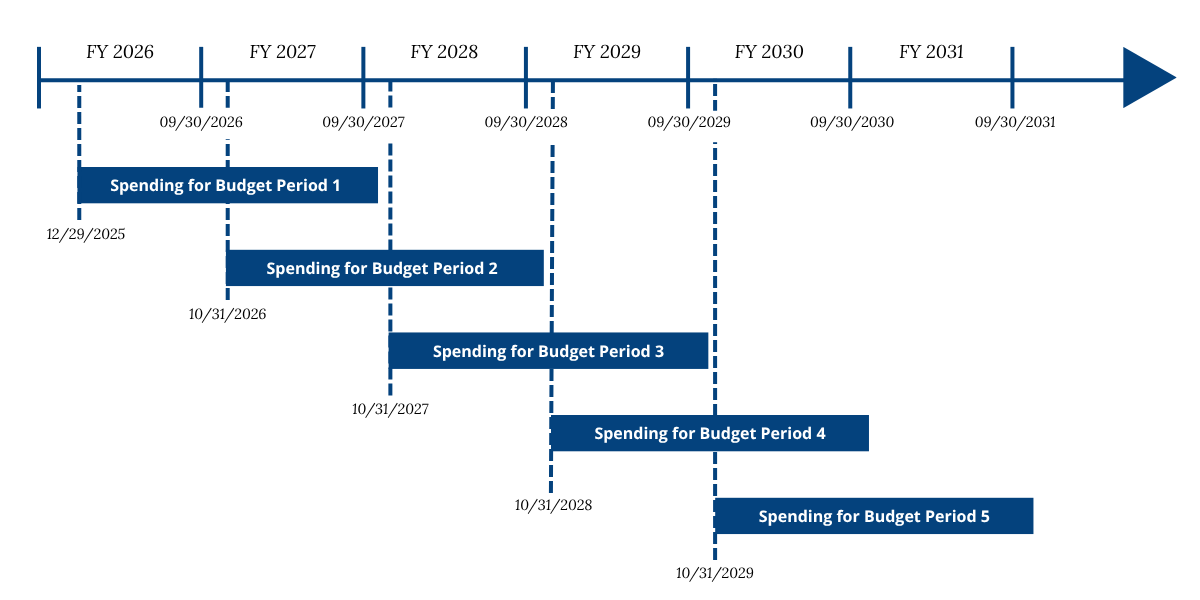
Funding is awarded in five annual budget periods. A key feature of the program is its flexibility; for each budget period, Missouri will have until the end of the following federal fiscal year (September 30) to spend the awarded funds.1 For example, funds awarded for the first budget period in early 2026 can be spent until September 30, 2027. This will require careful planning for complex, multi-year projects.
For each budget period, recipients will have until the end of the following fiscal year (September 30) to spend awarded funding.
- Recap: Budget Period will start on December 31, 2025. The Federal Fiscal Year begins October 1, but the subsequent Budget Period funding for RHTP will be distributed in November of each fiscal year.
- Key Limitations
Prohibited Uses
RHTP funds cannot be used for the following:
- New Construction: Building entirely new facilities is not allowed. However, funds can be used for renovations, alterations, or equipment upgrades in existing buildings.1
- Supplanting Funds: The money is intended for new or expanded activities. It cannot be used to replace or substitute existing state, local, or private funding for a project that is already underway or budgeted.1
- Duplicating Billable Services: Funds cannot be used to pay for clinical services that are already reimbursable through programs like Medicaid, Medicare, or private insurance. The goal is to transform care delivery, not just pay for more of the same services.1
- Lobbying: Federal funds cannot be used for activities designed to influence the passage of legislation or other government actions.1
Program-Specific Funding Caps
CMS has also set limits on how much of a state's annual award can be spent on certain categories. These caps ensure a balanced investment across different aspects of healthcare transformation.
Spending Category
Maximum Allowed
Administrative Costs (State-level program management, oversight) 10% of the state's total annual award1 Capital Expenditures (Renovations, equipment upgrades) 20% of the state's total annual award1 Provider Payments (For direct healthcare services not otherwise billable) 15% of the state's total annual award1 Replacing an Existing Certified EHR System 5% of the state's total annual award1 "Rural Tech Catalyst Fund" Initiatives (Funding for health tech startups) The lesser of 10% of the annual award or $20 million1 - New Construction: Building entirely new facilities is not allowed. However, funds can be used for renovations, alterations, or equipment upgrades in existing buildings.1
- Calculating Missouri's Award
The Federal Scoring Formula
The amount of competitive "Workload Funding" Missouri receives each year is determined by a formula that combines two distinct scores. Understanding this formula is key to maximizing the state's award.
Score 1: The Rural Facility and Population Score (The "Need" Score)
This score is a snapshot of Missouri's existing rural healthcare needs and challenges. It is calculated by CMS only once at the beginning of the program and will not change over the five years1. It is based on several data-driven factors, including:
- The total number of people living in rural areas of the state.1
- The number and proportion of rural health facilities, such as Critical Access Hospitals and Rural Health Clinics.1
- The level of uncompensated care provided by hospitals in the state.1
- The percentage of the state's total population that lives in rural areas.1
- The state's total land area and the presence of very remote "frontier" areas.1
- The percentage of hospitals that receive Medicaid Disproportionate Share Hospital (DSH) payments.1
Score 2: The Technical Score (The "Plan and Performance" Score)
This score measures the quality, strategic vision, and ultimately the performance of Missouri's transformation plan. This score is recalculated by CMS every year based on the state's progress.1 This annual rescoring is the program's core accountability engine. It turns the RHTP from a simple grant into a dynamic, performance-based partnership.
A typical grant provides funding based on an initial application, with reporting focused mainly on compliance. The RHTP, however, ties future funding directly to present performance. If Missouri successfully implements its planned initiatives and meets its policy commitments, its Technical Score—and its Workload Funding—can increase in subsequent years. Conversely, a failure to make progress or follow through on commitments can lead to a lower score and reduced funding. This structure creates a powerful incentive for the state and its partners to not only write a strong plan but to execute it effectively, requiring robust project management and transparent reporting from day one.

- Vision & Core Objectives
Vision
Rural Missourians have access to the high-quality care they need, through or from a well-aligned delivery system that is built to last.
Core Objectives
DSS is organizing and prioritizing initiatives in the application according to three overarching objectives:
Access to Care:
Ensure rural Missourians can access primary and behavioral health providers close to home, community-based maternity options, with connections to specialists and complex care enabled by telehealth and provider interoperability
Health Outcomes:
Strengthen healthcare quality through integrated care coordination, aligned incentives, and evidence-based practices – so rural Missourians consistently experience seamless, high-value care
Sustainability:
Strengthen the long-term sustainability of rural providers through targeted investments in infrastructure, adoption of innovative technologies, and payment models that reflect the realities of rural care delivery
- Initiatives
Missouri’s Initiatives
- Rural Health Network and Hubs
- Tech and Data Interoperability
- Rural Health Workforce Pathways
- Provider Transformation & Sustainability
- Rural Health Network and Hubs
- Rural Health Network and Hubs
Rural Health Network and Hubs
Create community hubs supported by regional networks as the backbone that connects every rural resident to seamless high-quality care through:
- Access expansion through and beyond traditional providers (e.g., pharmacy, Emergency Medical Services (EMS), Mobile Integrated Healthcare–Community Paramedicine (MIH-CP), Local Public Health Agencies (LPHA))
- Care coordination integrating physical, behavioral and social health services
- Technical assistance and programs tailored to local needs
- Rural Health Workforce Pathways
Rural Health Workforce Pathways
Create an integrated rural health workforce pipeline that connects education, training, and employment to grow and retain Missouri’s healthcare talent locally, including efforts on:
- New entry points into health careers through high school, college, and training programs
- Expanding maternal and behavioral health training opportunities
- Clinical placement and retention supports across rural communities
- Tech and Data Interoperability
Tech and Data Interoperability
Create a statewide backbone for data interoperability that connects hubs, providers, and local partners to coordinate care, including:
- Hub data integration
- Community Information Exchange (CIE) for closed-loop referrals and shared care plans
- Data standards and compliance
- Public health connectivity
- Provider Transformation & Sustainability
Provider Transformation & Sustainability
Ensure the long-term financial, operational, and sustainable future of Missouri’s rural healthcare system through:
- Strategic infrastructure access modifications
- Alternative payment innovations
- Operational innovation and tech-enablement

- Key Resources
- Inside Missouri's RHTP Newsletter
- ToRCH Care Hub Onboarding & Operations Procedures Manual
- ToRCH Care FAQs
- RHTP Hub County Groupings and RCNs Map
- Roadshow Resources
- RHTP Hub Anchor Application
- 5/15/2026 Press Release: Missouri Department of Social Services Releases ToRCH Care Hub Boundaries Ahead of Hub Anchor Application
- 5/15/2026 Press Release: Missouri Department of Social Services Invites Rural Organizations to Apply as ToRCH Care Hub Anchors
- 12/29/2025: MHA applauds Missouri’s $216 million RHTP award
- 12/29/2025 Press Release: Governor Kehoe Secures More Than $216 Million to Strengthen Rural Healthcare in Missouri
- Application Resources
- Governor Kehoe's RHTP Endorsement
- Background Information
Background Information
- Notice of Funding Opportunity Webinar, accessed October 15, 2025, https://www.cms.gov/files/document/rht-program-applicants-webinar-presentation.pdf
- Rural Health Transformation Program Summary, accessed October 13, 2025, https://www.ruralhealth.us/nationalruralhealth/media/documents/advocacy/2025/rural-health-transformation-program-summary.pdf
- CMS Releases State Guidance On Rural Health Transformation Program, accessed October 13, 2025, https://www.mohospitals.org/newsroom/cms-releases-state-guidance-on-rural-health-transformation-program/
- Missouri Department of Social Services Invites Public Comment on Rural Health Transformation Program - GovDelivery, accessed October 13, 2025, https://content.govdelivery.com/accounts/MODSS/bulletins/3ef7bd9
- Invitation to Comment: Rural Health Transformation Program - myDSS - MO.gov, accessed October 13, 2025, https://mydss.mo.gov/mhd/hot-tips/invitation-comment-rural-health-transformation-program
- Missouri Lawmakers Champion Rural Health, Unlocking Access to Quality Care for Rural Communities - Ways and Means Committee, accessed October 13, 2025, https://waysandmeans.house.gov/2025/09/23/missouri-lawmakers-champion-rural-health-unlocking-access-to-quality-care-for-rural-communities/
- DSS Seeks Input On Rural Health Transformation Program - Missouri Hospital Association, accessed October 13, 2025, https://www.mohospitals.org/newsroom/dss-seeks-input-on-rural-health-transformation-program/
- Billions on the Table: Missouri Invites Public to Shape Rural Health Future - Missourinet, accessed October 13, 2025, https://www.missourinet.com/2025/09/02/billions-on-the-table-missouri-invites-public-to-shape-rural-health-future/
- Missouri Department of Social Services seeking public help in planning for rural health innovatio... - YouTube, accessed October 13, 2025, https://www.youtube.com/watch?v=7B1VNbJueKc
- The $50 Billion Rural Health Transformation Program: What Providers Can Do Before Nov. 5, 2025, accessed October 13, 2025, https://www.lara.health/blog/the-50-billion-rural-health-transformation-program-what-providers-can-do-before-nov-5-2025
- Rural Health Transformation Program - Senate Finance Committee, accessed October 13, 2025, https://www.finance.senate.gov/download/rural-health-transformation-program_fact-sheet
- Notice of Funding Opportunity Webinar, accessed October 15, 2025, https://www.cms.gov/files/document/rht-program-applicants-webinar-presentation.pdf
Program Status and Timeline
| Event | Date / Deadline | Additional Resources |
|---|---|---|
| Missouri Awards $1.46 Million to Expand Childcare Support for Rural Health Workers | 10/13/2026 |
|
| Missouri Announces Certified Nurse Midwife Training Partnership to Strengthen Rural Maternal Care Workforce | 10/13/2026 |
|
| Expanding Behavioral Health Support for Rural Missouri Communities | 09/22/2026 |
|
| Missouri Announces Major Effort to Grow Rural EMS Professionals | 09/22/2026 |
|
| Missouri Awards $35 Million to Strengthen Rural Healthcare Infrastructure | 09/22/2026 |
|
| Missouri Seeks Vendor Input to Expand Telehealth Access in Rural Communities | 08/31/2026 |
|
| Missouri Announces Upcoming Grant Opportunity to Modernize Rural Healthcare Facilities | 07/29/2026 | |
| RHTP Initiative Aims to Significantly Expand Mobile Medical Services in Rural Missouri | 07/24/2026 | |
| Partnership to Expand Rural Maternal Healthcare Announced | 07/20/2026 | |
| Hub Anchor Organizations Announced | 07/17/2026 | |
| Digital Backbone Roadshows | 07/13-14/2026 | |
| Inside Missouri’s Rural Health Transformation Program (RHTP) Newsletter | 07/06/2026 | |
| Announce Investment in Home Visiting Services | 07/02/2026 | |
| ToRCH Care Hub Onboarding & Operations Procedures Manual Published | 06/30/2026 | |
| Alternative Payment Models (APM) Survey closed | 6/26/2026 | |
| Digital Readiness Survey Assessment Report Released | 06/24/2026 | |
| Open Applications for Medical Clerkships | 06/18/2026 | |
| Hub Anchor Application Due | 06/18/2026 | |
| Hannibal Virtual Roadshow | 06/04/2026 | |
| Sedalia Virtual Roadshow | 06/03/2026 | |
| Rolla Virtual Roadshow | 6/02/2026 | |
| Ambient AI Request for Information (RFI) | 6/01/2026 | |
| West Plains Virtual Roadshow | 5/27/2026 | |
| Branson Virtual Roadshow | 5/27/2026 | |
| RHTP ToRCH Care Roadshows | May-June 2026 | |
Hub Anchor Application Webinar | 04/17/ 2026 | |
| ToRCH Care Hub Anchor Application Released | 05/15/2026 | |
| ToRCH Care Hub Boundaries Map Released | 05/15/2026 | |
| ToRCH Care Community Institutions Webinar | 05/13/2026 | |
| ToRCH Care Non-Hospital Clinical Providers Webinar | 05/6/2026 | |
| Inside Missouri’s Rural Health Transformation Program (RHTP) Newsletter | 05/04/2026 | |
| ToRCH Care Hospital Specific Webinar | 04/29/2026 | |
| Invitation for Bid for Vital Rural Hospital Repairs | 4/27/2026 | |
| ToRCH Care Overview Webinar | 04/22/2026 | |
| Digital Readiness Survey | 04/17/2026 | |
| RHTP Year One Budget Approved | 04/7/2026 | |
| MHA applauds Missouri’s RHTP award | 12/29/2025 | |
| Governor Kehoe Secures More Than $216M | 12/29/2025 | |
| Public Comment Invited on RHTP | 08/26/2025 | |
| RHTP Application Materials | 11/2025 | |
| Governor Kehoe's RHTP Endorsement | 10/31/2025 |
The Rural Health Transformation Program information provided by the Missouri Department of Social Services is supported by the Centers for Medicare & Medicaid Services (CMS) of the U.S. Department of Health and Human Services (HHS) as part of a financial assistance award totaling $216,276,817.66, with 100 percent funded by CMS/HHS. The contents are those of the author(s) and do not necessarily represent the official views of, nor an endorsement by, CMS/HHS, or the U.S. Government.